
Funding for centers that map senescent cells in diseased tissue
 Play the video: Funding for centers that map senescent cells in diseased tissue
What they want
The Common Fund wants Discovery and Validation Centers (DVCs), the core research centers of Stage 2 of the Cellular Senescence Network. A DVC defines, refines and validates tissue- and disease-relevant senescence signatures (“senotypes”) and biomarkers, studies what they do in human health and disease, and produces molecular, cellular and spatial datasets for public Senescence Atlases. [Part 1: Purpose; Sec I]
Each center focuses on at least two diseased tissue types. Developing senotherapeutics is not a goal. [Sec I]
Every application must also propose the SenNet Organization and Outreach Component (SOOC), the consortium’s central administrative hub. NIH will fund the SOOC role for only one awardee across this notice and the data center notice (RFA-RM-27-025). [Part 1: Purpose; Sec II]
Clinical trials are not allowed. [Sec II]
Who's in, who's out
You're in if
- A US organization: universities, nonprofits, for-profits, governments, federal agencies, US territories. [Sec III.1]
- PD/PI effort of at least 2.4 calendar months (multi-PI: 2.4 combined, at least 1.2 for one PI). [Sec IV.2, Level of Effort]
- Each Element Leader at 1.5 calendar months (at least 1.0 if co-led). [Sec IV.2, Level of Effort]
- A complete SOOC proposal and a detailed Resource Sharing Plan. [Sec IV.2]
- More than one application per organization is fine if each is scientifically distinct. [Sec III.3]
You're out if
- Foreign organizations, non-US parts of US organizations, and foreign components. [Sec III.1]
- Foreign subawards or subcontracts: noncompliant, not considered for funding. [Sec III.1]
- Basic mechanism research that doesn’t generate or validate biomarkers and senotypes: non-responsive. [Sec I]
- Sharing practices that restrict, block or delay access to SenNet tools and resources: non-responsive. [Sec IV.2]
- Duplicate or highly overlapping applications under review at the same time. [Sec III.3]
The money
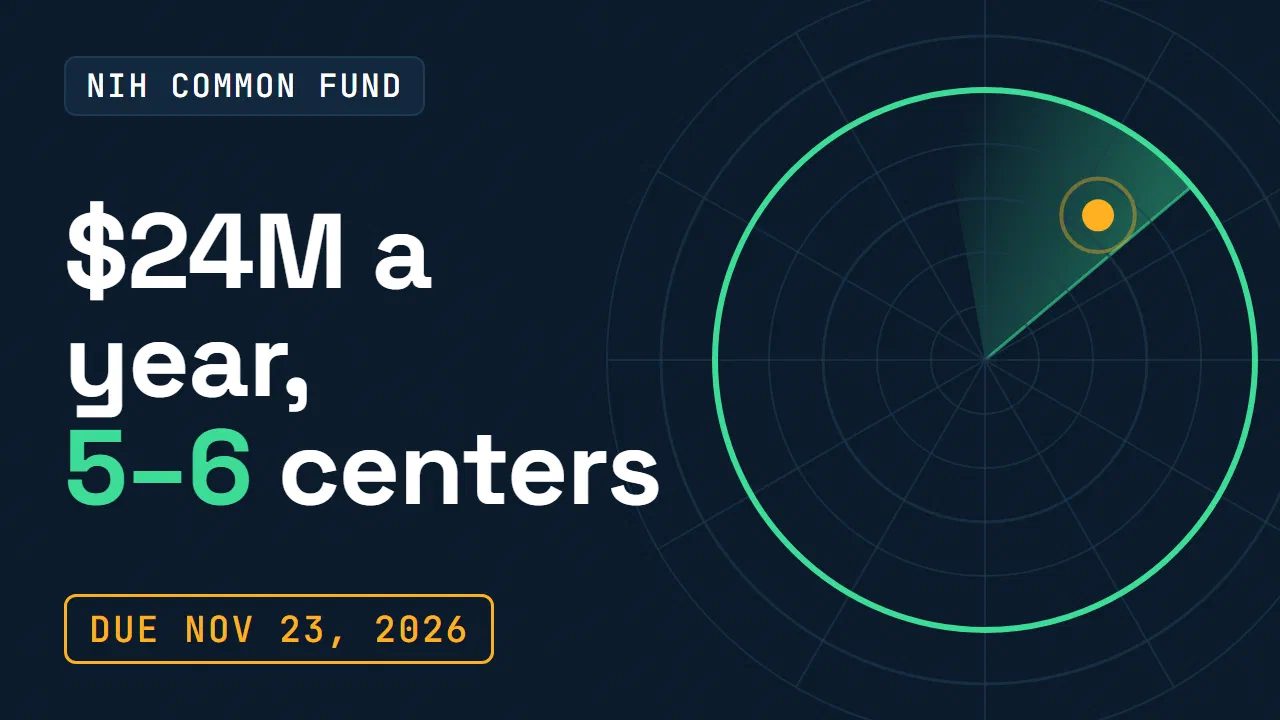
The Common Fund intends to fund 5 to 6 centers, $24 million per year in total. Future amounts depend on appropriations. [Sec II]
- Budget limit: approximately $3 million per year in direct costs.
- SOOC element: request exactly $600,000 a year in direct costs; 40 to 45% of it each year goes to SenNet education (junior investigator fellowships, summer undergraduate internships).
- Cross-consortium validation set-aside: about 10% of the total budget from year 2, restricted (NIH prior approval to use or move it).
- Up to 5 years. No cost sharing. [Sec II; Sec III.2; Sec IV.2, Budget]
Key dates
| Opens for submission | Oct 23, 2026 |
|---|---|
| Application due | Nov 23, 2026 |
| Notice expires | Nov 24, 2026 |
Track record
Past awards weren’t checked for this episode, which was made before Grant Radar added that step.For your research office
A note you can forward to your research office and finance office. The same note is in the video description.
Subject: Intent to apply: RFA-RM-27-016, due November 23, 2026
I plan to apply to RFA-RM-27-016, “Cellular Senescence Network (SenNet): Discovery, Validation Centers (UM1 Clinical Trials Not Allowed)” (NIH Common Fund; administered by the NIA).
- Due: November 23, 2026, 5:00 PM local time of the applicant organization. Opens for submission October 23, 2026. [Part 1: Key Dates]
- Budget: limited to approximately $3 million per year in direct costs, up to 5 years. The SOOC element asks for exactly $600,000 a year in direct costs. [Sec II; Sec IV.2, Budget]
- Cost sharing: not required. [Sec III.2]
- Applications per organization: more than one is allowed if each is scientifically distinct. [Sec III.3]
- Registrations needed: SAM.gov (with UEI), Grants.gov and eRA Commons for the organization; an eRA Commons account and an ORCID ID for every PD/PI. Allow 6 weeks or more. [Sec III.1]
- Institutional items: letters of support from the parent organization showing dedicated space, protected staff time, equipment and financial support; a Resource Sharing Plan and a Data Management and Sharing Plan. [Sec IV.2]
- Effort to check: PD/PI at least 2.4 calendar months; each Element Leader at least 1.5. [Sec IV.2, Level of Effort]
- Foreign partners: no foreign subawards or subcontracts. [Sec III.1]
- Contacts in the notice: science and grants management questions, CS2@nih.gov. [Sec VII]
To confirm with you: the internal deadline and anything on this list that needs a signature.
Sources
Bracketed references such as [Sec III.1] point to sections of the official notice.
Read the official notice RFA-RM-27-016
Transcript
On October ninth, the NIH Common Fund posted funding for the research centers at the heart of its Cellular Senescence Network, SenNet. The notice is called SenNet Discovery and Validation Centers, and it's a U-M-1 cooperative agreement. It's for a team ready to map senescent cells in at least two diseased tissues and share everything it generates. It's also for the research office deciding whether the institution can carry a center. By the end, you'll know what it pays, the component every applicant has to propose, what stops an application before review, and whether to pursue it, skip it or forward it. There's one due date, November twenty-third, and requests to reconsider the review won't be accepted.
Start with the funding, because the budget comes with set-asides you can't spend freely. The Common Fund intends to fund five to six centers, with a total of twenty-four million dollars a year. Each budget is limited to about three million dollars a year in direct costs, for up to five years, with no cost sharing. From year two, about ten percent of your total budget is set aside for validation work across the consortium, and you'll need NIH approval to use it. The notice describes the funding as running from fiscal year twenty twenty-seven to twenty thirty-two, which is six years, while the maximum project period is five. Plan for five, and ask the program about the difference.
Next, the part every applicant has to write, even though only one will be funded for it. It's called the SenNet Organization and Outreach Component, or SOOC, and it runs the consortium's meetings, working groups and policies. NIH will fund the SOOC role for just one awardee across this notice and the data center notice. Even so, an application without a complete SOOC proposal is considered incomplete. Its budget is set at exactly six hundred thousand dollars a year in direct costs. Forty to forty-five percent of that goes to SenNet education programs, such as fellowships for junior investigators and summer internships for undergraduates. The notice doesn't say whether the six hundred thousand sits inside the three million or on top of it, so ask before you build the budget.
Then the science, because one kind of application is non-responsive and won't be reviewed. Each center studies at least two diseased tissue types. It defines disease-specific senotypes and biomarkers, builds and validates preclinical models, and runs high-throughput pipelines with at least two core assays, such as multiplexed immunoassays or single-cell multiomics. The results become two- and three-dimensional maps of senescent cells in disease tissue, shared openly with the consortium. Developing senotherapeutics is not a goal of the program. The rule that ends an application is about focus. Basic research that chases a biological mechanism without generating or validating biomarkers and senotypes is non-responsive.
Then who can lead a center. The effort minimums are high, so count them before you name anyone. US organizations of almost every kind are eligible. Foreign organizations can't apply, and neither can branches of US organizations based outside the country. Foreign components and foreign subawards aren't allowed either. The PI, or the PIs together, must commit at least two point four calendar months a year, with at least one PI at one point two. Each element of the application needs a leader at one point five months, and effort as PI doesn't count toward a leader role. Your institution also has to show its support in letters, with dedicated space, protected staff time, equipment and funding.
Next, what you'd write. The research strategy is capped at thirty pages, in four elements, plus a one-page specific aims. Element A, up to five pages, sets out your vision, governance and yearly milestones. Reviewers will look closely at how you balance deep biology with building a community resource. Each year, your center is judged on two milestones: data accepted by the data center after quality control, and that data's public release. Elements B and C, up to ten pages each, cover your models and validation, and then your biospecimens, assays and maps. Element D, up to five pages, is the SOOC. Two more rules matter. Consent forms should allow broad data sharing, and restrictive consent plans count against you in review. And sharing practices that restrict or delay access to SenNet tools are non-responsive.
Then the dates. Submissions opened on October twenty-third. The only due date is November twenty-third, twenty twenty-six, at five PM your local time. Your organization needs SAM dot gov with a U-E-I, Grants dot gov and eRA Commons, and every PI needs an eRA Commons account linked to an ORCID. The notice says to allow six weeks or more for registrations. That window has already passed, so this deadline only works if yours are done. Peer review is in March, the National Advisory Council on Aging meets in May, and the earliest start is July twenty twenty-seven. A pre-application webinar is planned. Email the address on screen for details.
Lastly, how it's judged. Generally, only the top half of applications are discussed and scored, and requests to reconsider the review won't be accepted. Reviewers will ask whether you've struck the right balance between studying senotypes and building a resource, and between innovation and scale. They'll ask whether your models have enough preliminary data and throughput to produce validated biomarkers, and whether your team has run consortium work before. Funding also weighs program balance, meaning a spread of tissues, diseases and perspectives across the centers. So, if you lead a team that can map senescence in two diseased tissues and share data at atlas scale, this is worth pursuing. If your project is mechanism-focused basic biology, it won't fit. And if your strength is building tools, look at the technology projects notice on screen.