Research Centers on how infection and inflammation drive chronic disease
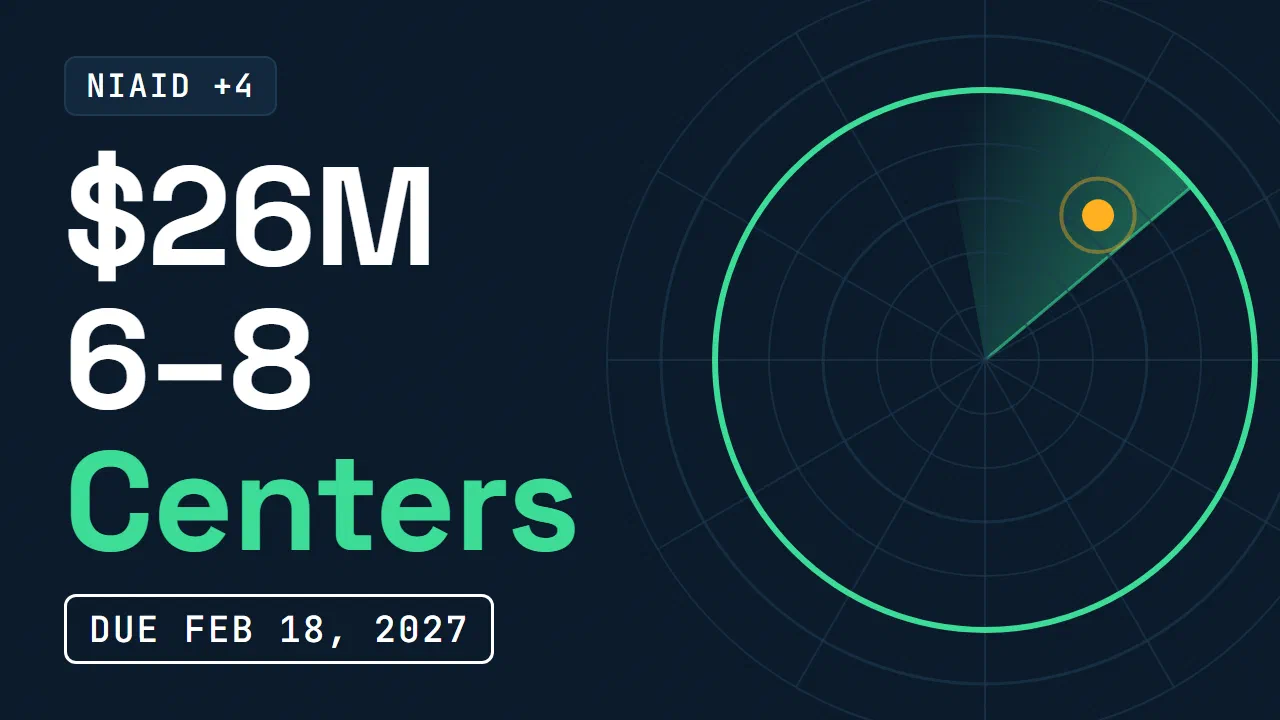 Play the video: Research Centers on how infection and inflammation drive chronic disease
What they want
NIH wants large research Centers that study how infections and inflammation lead to, or worsen, long-term chronic diseases. Centers combine patient data, large lab datasets (“omics”) and AI or computer modeling to find new drug targets, biomarkers and better ways to classify disease. [Part 1: Purpose; Sec I]
You apply for one of two Center types: CIDSB, which links infections (for example Lyme, flu, RSV, TB, Epstein-Barr) to chronic diseases, or SBI, which studies inflammation across chronic diseases already studied in NIH’s Accelerating Medicines Partnership (AMP) program. [Sec I; Sec IV, Overall Research Strategy]
Every Center must use longitudinal human clinical samples with clinical data. This is a cooperative agreement, so NIH staff are actively involved after the award. [Sec I; Sec II]
Who's in, who's out
You're in if
- Universities, nonprofits, for-profits including small businesses, state, local and tribal governments, federal agencies and other US entities. [Sec III.1]
- Anyone with the skills and resources to lead the work, applying through an eligible organization; multiple PIs are allowed. [Sec III.1]
- New applications only. [Sec II]
- SBI applicants: data or specimens from AMP and at least 3 chronic diseases, including one neurodegenerative and one autoimmune disease. [Sec IV, Overall]
- Unfunded foreign collaborators and foreign consultants. [Sec III.1]
You're out if
- Foreign organizations, and non-US parts of US organizations. [Sec III.1]
- An application without longitudinal human clinical samples with clinical data. [Sec I]
- Research on the pathogen only, or only computational or software tools, or HIV/AIDS research. [Sec I]
- A proposed clinical trial. [Sec II]
- Foreign subawards or subcontracts, and resubmissions or renewals. [Sec III.1; Sec II]
The money
About $26,000,000 in total in fiscal year 2028: $18,500,000 from NIAID for 5 to 6 CIDSB Centers and $6,000,000 from NIA and NIAMS for 1 to 2 SBI Centers. [Sec II]
- CIDSB cap: $2,500,000 in direct costs per year. SBI: no cap, but the budget must match real needs. [Sec II]
- Length: exactly 5 years. [Sec II]
- No cost sharing. [Sec III.2]
Key dates
| Opens for submission | Jan 18, 2027 |
|---|---|
| Application due | Feb 18, 2027 |
| Notice expires | Feb 19, 2027 |
Track record
Past awards weren’t checked for this episode, which was made before Grant Radar added that step.For your research office
A note you can forward to your research office and finance office. The same note is in the video description.
Subject: Intent to apply: RFA-AI-28-014, due February 18, 2027
I plan to apply to RFA-AI-28-014, “Systems Biology of Infection and Inflammation in Chronic Diseases (U19 Clinical Trial Not Allowed)” (NIAID and other NIH institutes).
- Due: February 18, 2027, 5:00 PM local time of the applicant organization. One cycle only. Opens for submission January 18, 2027.
- Center type: we must choose one, CIDSB (infection) or SBI (inflammation), and say so clearly.
- Budget: CIDSB up to $2,500,000 in direct costs per year; SBI has no cap but must match real needs. 5 years. About $26,000,000 in total across the program in fiscal year 2028.
- Cost sharing: not required.
- What we submit: an Overall section (12 pages), an Administrative Core (6), a Data and Modeling Core (12), a Biospecimen Collection and Processing Core (6), and Research Projects (12 each): exactly 3 for CIDSB, 2 or 3 for SBI. CIDSB also requires a Technology Development Core (6) and a Validation and Translation Core (12).
- Effort minimum to check: each Core or Project lead at least 0.6 person-months.
- Must-haves to confirm: longitudinal human clinical samples with clinical data; a travel budget for a kick-off meeting and annual meetings near Bethesda, MD.
- Registrations needed: SAM.gov (with UEI), Grants.gov and eRA Commons for the organization; an ORCID ID for every PI. Allow 6 weeks or more.
- Contacts in the notice: science questions, niaidogat@mail.nih.gov (notice number in the subject line).
To confirm with you: the internal deadline, which Center type fits our samples, and who leads each Core and Project.
Sources
Bracketed references such as [Sec III.1] point to sections of the official notice.
Read the official notice RFA-AI-28-014
Transcript
Welcome to Grant Radar. On November fourth, the NIH posted about twenty-six million dollars for new research Centers. The notice is called Systems Biology of Infection and Inflammation in Chronic Diseases. If your lab studies how an infection or chronic inflammation drives a chronic disease, and you have longitudinal patient samples, this notice is aimed at you. In the next three minutes, you'll know which of the two Center types fits your work, what gets an application returned without review, and whether to pursue it, skip it or forward it. There's one deadline, and only new applications count. A Center application runs to six or more sections, written by a whole team. If it's returned without review, none of that work reaches a study section.
Start with the money. Most of it goes to one Center type, and that affects your odds. The notice puts about twenty-six million dollars into fiscal year twenty twenty-eight, across five institutes. The National Institute of Allergy and Infectious Diseases, the NIAID, has eighteen and a half million for five or six infection Centers. The National Institute on Aging and the National Institute of Arthritis and Musculoskeletal and Skin Diseases have six million between them, for one or two inflammation Centers. The National Institute of Dental and Craniofacial Research adds up to one million. The National Eye Institute adds five hundred thousand a year for eye-imaging data. The notice doesn't tie those last two amounts to either Center type, so if you want that money, ask those two institutes directly. Infection Centers are capped at two and a half million dollars a year in direct costs. Inflammation Centers have no cap, but the budget has to match real needs. Every award runs exactly five years, with no cost sharing.
You apply for one Center type, and you name it up front. The two types need different Cores and a different number of Projects, so switching late means rebuilding the application. Universities, nonprofits, companies and government agencies can all apply, as long as they're US-based organizations. Foreign organizations are excluded, as are any branches or divisions of US organizations that are based outside the country. The infection Center links an infection to a chronic disease. The notice's examples include Lyme disease, flu, TB and Epstein-Barr, tied to conditions like IBD, cancer, and heart or neurological disease. The inflammation Center studies inflammation across chronic diseases already covered by the NIH's Accelerating Medicines Partnership, called AMP. The inflammation Center has three extra rules. You must use AMP data or specimens. You must cover three or more chronic diseases, and at least one has to be neurodegenerative and one autoimmune. If you can't meet all three, the inflammation Center is out.
Now, you should remember that there is only one deadline and no resubmissions,. This means there's no second chance for this application, so you need to keep the following eight rules that will automatically send your application back without review in mind. If you violate these rules, your application gets no score. The first four are about the science itself. To qualify, first, you need longitudinal human clinical samples with clinical data. Second, you have to study the host, so a pathogen-only study is out. Third, any proposal that only builds computational or software tools is out and lastly any research involving HIV or AIDS. The other four are more focused on how you apply for this grant and the first is, Proposing a clinical trial gets it returned. No clinical trials are allowed for this grants. Then there is the issue of Foreign subawards and subcontracts which are expressly prohibited. You can still work with unfunded foreign collaborators and consultants though with the key term there being: Unfunded.. Also there is a strict no-contact, no-mention policy on any possible Scientific Advisory Group members before the award. And lastly, any application that's late, incomplete or missing a registration goes back unread. Be sure to keep all these in mind as you prepare your application and you might want to make check with all participants and institutions you work with before you write a page.
If you're still in, it's time to look at what you'd actually be building. Every Core and every Project needs its own lead, which means this part decides how many senior people you need signed on before anyone starts writing. Whichever Center type you choose, the application has an Overall section and three Cores. Those are the Administrative Core, the Data and Modeling Core, and the Biospecimen Collection and Processing Core. The infection Center then adds two more required Cores, Technology Development, and Validation and Translation, plus exactly three Research Projects. The inflammation Center can leave those two Cores out, and it needs two or three Projects. Be careful with the page-limit table in the notice, because it lists those two Cores as optional. That table covers both Center types at once. The instructions directly below it make them required for the infection Center. There are also a few commitments to plan for. Each Core or Project lead has to commit at least zero point six person-months of effort. You'll need to budget for travel to a kick-off meeting, and to annual meetings near Bethesda. And the Overall section needs a year-by-year plan, with most enrollment and sample collection in years one to three, then analysis, modeling and validation in years four and five.
Before the deadline itself, look at the registrations. If even one of them isn't finished in time, the application counts as late, and late applications go back without review. You'll need four of them: SAM dot gov with a U-E-I, Grants dot gov, eRA Commons, and an ORCID for every PI. The notice says to allow six weeks or more. Submissions open on January eighteenth, twenty twenty-seven. Applications are due February eighteenth, twenty twenty-seven, at five PM your local time. After that, peer review happens in July, the advisory council meets in October, and the earliest start date is January twenty twenty-eight. Six weeks before the deadline is January seventh, so get your registrations started before then.
Lastly, the review. Reviewers will score your application on the standard NIH criteria, and the notice adds one extra question on top of those. Every section of your application should be written with that question in mind. Reviewers will ask how well your Center will produce useful predictive models that link infection, inflammation and chronic disease. The NIAID encourages science questions before you apply. Email the address on screen, and be sure to put the notice number in the subject line. So, if you have the samples, the team, and a clear fit for one Center type, this one is worth pursuing. If you're missing any of those, forward it to a colleague who has them.